
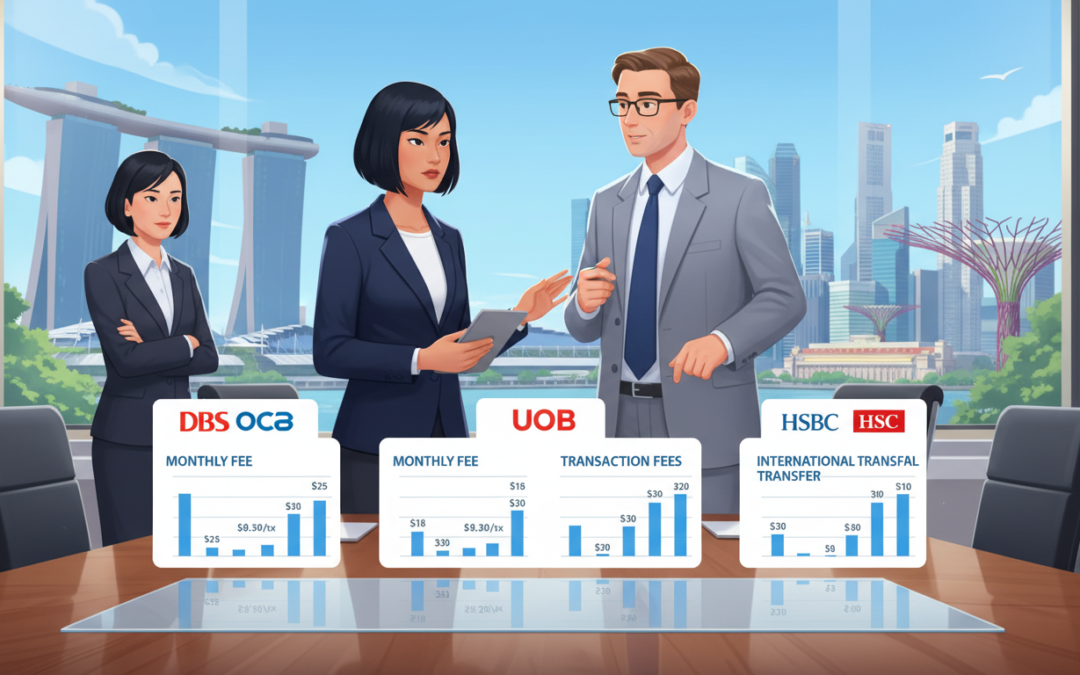
“What gets measured gets managed.” Peter Drucker captures the crux of choosing the right financial partner.
The guide sets out a practical, like‑for‑like look at total cost of ownership for SME accounts. It compares traditional names such as DBS, OCBC and UOB with digital providers like Wise and Revolut, and shows when each typically wins on cost and fit.
This introduction explains what “fees” will mean here: monthly and annual maintenance, fall‑below charges, local transfer rates (FAST/GIRO/PayNow), TT costs, FX mark‑ups and service charges. The focus is on outcomes that matter: cash flow predictability, admin burden, payment speed and scalability as your company grows.
Key Takeaways
- This guide compares singapore business bank account fees comparison in a like‑for‑like way that focuses on total cost.
- It is aimed at SMEs, start‑ups and growing firms weighing traditional banks and digital providers.
- Fees covered include maintenance, fall‑below, local and international transaction charges and FX mark‑ups.
- Decisions should prioritise cash flow predictability, operational fit and scale‑ability.
- Later sections explain what to check before choosing and tactics to reduce charges in 2026.
Why business bank account fees matter for Singapore SMEs and growing businesses
Small, steady banking charges can quietly erode working capital and change how a firm plans growth.
Recurring fees reduce the cash available for payroll, stock and investment. For an sme with uneven inflows, that distortion can make monthly forecasts misleading. Over a year, maintenance and per-transfer charges add up.
Minor per-transaction costs matter when multiplied across payroll runs, vendor payments and subscriptions. Each extra charge raises operational costs and reduces margin. Multiple small debits become a predictable line in the P&L.
Fee leakage hits profitability and slows business growth. As headcount or sales rise, so do the number of transactions and the total take from the bottom line. Low headline prices often hide fair‑use caps, bundle thresholds or manual processing surcharges that kick in as activity grows.
Foreign exchange mark-ups are a common hidden expense for internationally active firms. They can exceed explicit transfer charges and quietly reduce receipts from cross‑border payments. Choose the product that fits your payment patterns, not the cheapest single headline.
| Impact area | How it affects cash | What to check |
|---|---|---|
| Recurring charges | Lower working capital each month | Monthly maintenance and waiver rules |
| Per-transfer pricing | Adds up with many transactions | Per-item cost and free‑transfer limits |
| FX mark-ups | Reduces foreign receipts | Compare mid-market rates and mark-ups |
What to check before choosing a business account
Choosing the right product reduces surprises and preserves cash.
Eligibility and setup
Most providers require a locally registered entity and standard company documents for onboarding. Rules differ between providers, so confirm acceptable forms of ID, shareholder lists and incorporation papers before you apply.
Minimum initial deposit vs minimum balance
Understand the distinction. A minimum initial deposit is what you must place when opening the account. A minimum balance is what you must keep to avoid charges.
Keeping money locked to meet a minimum balance reduces usable cash for payroll, stock or marketing. That effect matters for cash flow planning.
Average daily balance and fall-below triggers
The average daily balance is the mean of daily balance snapshots across the month. If your daily balance falls below the threshold on several days, a fall-below charge can apply.
Check whether providers measure the average daily balance or require a minimum at month-end. The timing affects when penalties are triggered.
Online banking, support and branch services
Review online features: multi-user access, maker-checker controls, bulk payments and accounting integration. These reduce admin time and risk.
Also check service charges for counter transactions, cheque deposits and manual amendments — branch services sometimes carry extra costs.
Scalability
As needs grow, expect tiered plans, multi-currency features and relationship support. Confirm how easily you can add payment rails, credit facilities or higher transaction limits.
“Read the small print on balance rules — the cost of convenience is often hidden there.”
| Check | Why it matters | How providers differ | What to ask |
|---|---|---|---|
| Eligibility | Determines approval speed | Local registration often required | Which documents and timelines? |
| Initial deposit | Upfront cash requirement | Fixed sum or tiered | Is it refundable or usable? |
| Minimum / average daily balance | Affects usable liquidity | Measured daily vs month-end | How are fall-below charges calculated? |
| Services & support | Operational efficiency | Online-first vs branch-led | What costs apply to manual help? |
- Confirm eligibility and documents with the provider.
- Compare initial deposit and ongoing minimum balance rules.
- Test online features and clarify branch service pricing.
Bank charges explained: the fee types you’ll see in Singapore
A quick scan of a statement shows where costs sit. They normally group into admin, transaction, card/cash, FX and document service charges.
Administrative charges
Maintenance is usually monthly or annual. Fall‑below penalties apply when required balances are missed.
Expect early closure fees if you shut an account within 6–12 months. Inactivity or dormant fees kick in after months without movement.
Transaction rails and cross‑border transfers
Local rails include FAST (near‑instant), GIRO (recurring bulk payments) and PayNow (instant pay‑by‑ID). MEPS is used for higher‑value local transfers but can cost more.
Telegraphic transfers (TT) cover international payments. Total cost often adds handling fees, cable charges and intermediary bank deductions.
Cheque, card and cash items
Cheque services still incur charges: book issuance, clearing, returned items and stop‑payment fees.
Card and ATM costs include issuance or replacement fees, foreign card conversion surcharges and cash deposit or withdrawal charges at selected branches.
FX, multi‑currency and document services
Conversion mark‑ups typically range around 1–3% at larger providers; foreign card spends can add similar surcharges.
Document and digital charges cover paper statements, certificate letters, audit confirmations and paid alerts beyond free tiers.
- Tip: Match the rail to the payment need—use GIRO for regular payroll and FAST/PayNow for urgent transfers.
- Tip: Check total TT costs: sender, intermediary and receiver charges add up.
| Category | Typical charge type | What to check |
|---|---|---|
| Administrative | Monthly/annual maintenance, fall‑below | Waiver rules and measurement period |
| Transactions | FAST, GIRO, PayNow, MEPS, TT | Per‑transfer price and free tier limits |
| FX & cards | Conversion mark‑up, foreign card surcharge | Compare to mid‑market rate and cashbacks |
Singapore business bank account fees comparison across banks and digital providers
Not all plans are equal — compare core terms, then stress‑test them against your monthly run‑rate.
At‑a‑glance framework
- Minimum balance rules and any initial deposit requirement.
- Fixed charges: monthly fee or annual equivalent and promotional waivers.
- Key payment costs: local transfers (FAST/GIRO), international TT and FX spreads.
Illustrative pricing
DBS starter bundle: S$10/month with unlimited free local transfers and ~S$30 for international TT. OCBC: S$10/month (first 2 months waived), minimum deposit S$1,000 and S$15 fall‑below. UOB: S$35 annual with a S$5,000 balance expectation (waiver for 12 months). Maybank: fall‑below S$10 if ADB
How to compare like‑for‑like
Convert annual charges into monthly equivalents. Apply any waiver periods to your first‑year model and then model the post‑promotion cost. Confirm whether “free local transfers” covers both FAST and GIRO and whether a monthly quota applies.
Typical pricing patterns
Many digital providers lead with zero minimum balance and low fixed costs. Traditional banks may bundle free online local transfers but expect fall‑below rules, branch processing surcharges and higher ADB expectations.
| What to capture | Why it matters | Example data point |
|---|---|---|
| Minimum initial deposit / minimum balance | Impacts usable liquidity | S$1,000 or none |
| Monthly fee / annual fee | Predictable fixed cost | S$8–S$10/month or S$35/year |
| Local & international transfer costs | Drives transaction operating cost | Free FAST/GIRO online; S$30 TT |
Checklist: capture minimum balance, average daily balance rules, fall‑below charge, monthly fee, local transfer fees, international transfer fees, FX spreads and manual/branch charges before you decide.
Digital providers vs traditional banks: which usually costs less in 2026?
Choosing between a digital-first provider and an established bank comes down to how your firm moves money, and how much value you place on in-person services.
Digital-first accounts typically minimise fixed charges and remove minimum balance constraints. They often have faster online onboarding, simpler pricing and competitive FX rates. These options suit cashless firms, frequent international payers and teams that rely on virtual cards and expense controls.
Traditional banks charge more for branch access and relationship support, but they provide cash handling, cheque services and trade or lending facilities. For firms that need regular cash deposits, in-branch help or a manager to negotiate credit, conventional providers can be better value despite higher headline costs.
Decide by mapping how customers pay you and how you pay suppliers. If most inflows arrive via bank transfer, PayNow or card, and you convert currencies daily, a digital option usually lowers operating costs. If you process cash, cheques or need bespoke trade services, a traditional route can reduce operational friction.
| Feature | Digital-first | Traditional banks |
|---|---|---|
| Onboarding speed | Hours to days | Days to weeks |
| Minimum balance | Often none | Commonly required |
| Cash & cheque handling | Limited or none | Full branch support |
| Trade finance & lending | Limited | Comprehensive |
| FX & international transfers | Competitive mid-market options | Wider correspondent networks |
- Match your payment mix to provider strengths.
- Model monthly transaction volumes and FX needs.
- Choose the option that keeps operational work simple and predictable.
Traditional banks: fees and features you can expect
Established financial institutions typically offer broad services, yet their tariff structure needs careful modelling.
DBS — Starter multi‑currency bundle
DBS positions a Starter bundle for firms incorporated under three years. The package charges S$10 per month and carries no minimum balance.
The account holds 13 currencies and includes unlimited free local FAST & GIRO via DBS IDEAL. International transfers typically cost S$30, while branch services may incur extra charges.
OCBC — Business Growth Account
OCBC’s Business Growth Account asks for a S$1,000 minimum and a S$10 monthly fee (first two months waived).
Fall‑below charges run at S$15. Local payments may be bundled, which helps payroll and bulk runs. International transfers are commonly around S$30; an early closure fee can apply.
UOB — eBusiness account
UOB eBusiness levies a S$35 annual fee and expects an ADB near S$5,000 to avoid fall‑below penalties.
Start‑ups get a 12‑month waiver for the fall‑below charge of S$15. International TT costs vary (min S$10, max S$100) plus cable and agent charges.
Maybank — FlexiBiz
Maybank FlexiBiz triggers a S$10 fall‑below when the average daily balance falls under S$1,000.
Outward remittances use a percentage commission (0.125%) with a S$20–S$100 floor/ceiling, plus agent and cable fees — this can raise the total cost of international transfers.
CIMB — SME offering
CIMB SME waives the S$8 monthly fee for the first year and requires no minimum balance, so there is no fall‑below penalty initially.
Local transfers via BizChannel are free in the first 12 months, then may cost up to S$15 per transfer. Understand post‑waiver transfer pricing before you commit.
- Typical charges at traditional providers: fixed monthly or annual fees, fall‑below penalties linked to minimum or average daily balance, and different prices for online versus branch transactions.
- Match a provider to your needs: cash/cheque handling and branch services versus mainly online transfers and multi‑currency use.
| Provider | Price points | Balance rule | Local / Intl transfers |
|---|---|---|---|
| DBS | S$10/month; no minimum balance | No ADB requirement | Free FAST & GIRO; S$30 TT |
| OCBC | S$10/month (2 months waived) | Minimum S$1,000; S$15 fall‑below | Local included in packs; S$30 TT |
| UOB | S$35/year | ADB S$5,000 to avoid S$15 fall‑below (12‑month waiver) | TT S$10–S$100 + cable/agent |
| Maybank | No fixed monthly shown | ADB S$1,000 triggers S$10 fall‑below | Remit 0.125% (min S$20,max S$100) + agent/cable |
| CIMB | S$8/month (12 months waived) | No minimum balance | Free via BizChannel 12 months, then up to S$15/transfer |
Digital and non-bank providers: fees and features you can expect
Digital challengers reshape how firms pay and receive money, with clearer per‑transaction pricing and fewer balance traps.
Wise Business
Wise charges no ongoing monthly fee but has a one‑time S$99 setup for full services. It supports 40+ currencies, offers local bank details, debit cards and batch transfers.
International payments start from ~0.31% of the transfer value, making Wise a strong fit for frequent FX users.
Aspire
Aspire requires no minimum balance and waives monthly charges. It includes free local transfers, virtual and physical cards and accounting software links.
International transfers start around US$8 and integrations cut reconciliation time for small teams.
Airwallex
Airwallex uses plan tiers (~S$0–S$399/month). It supports 20+ currencies, free local transfers and international payments generally between S$20–S$35.
Price in any card or payment‑acceptance add‑ons if you handle customer payments.
Revolut
Revolut offers tiered plans (~S$0–S$417/month) and 25+ currencies. Local transfers can be ~S$0.20 and some international payments ~S$8, but fair‑usage limits apply.
Youbiz
Youbiz has no monthly charge, supports 9 currencies, offers cashback and Xero integration. Check variable transfer charges before high-volume use.
- Fit summary: e‑commerce: Airwallex or Revolut; agencies/consultants: Aspire or Youbiz; import/export firms with many currencies: Wise.
Comparing minimum balance and average daily balance rules across providers
Minimum balance rules quietly shape how much cash you can use each month. Providers set common thresholds such as S$1,000 and S$5,000 that directly constrain liquidity for payroll, stock and short-term expenses.
Common thresholds and what they mean
- S$1,000: a frequent threshold (OCBC, Maybank examples). Falling below often triggers modest fall-below penalties that bite monthly cash flow.
- S$5,000: higher-tier requirement (UOB example) that preserves a larger cushion but ties up working capital, especially for early-stage firms.
How providers calculate compliance
Some measure a monthly average while others use the average daily balance. A single end-of-month top-up may not help if your daily balance dips mid-month.
How fall-below charges accumulate
Small monthly penalties compound. For example, a S$15 fall-below each month equals S$180 per year — often more than switching to a digital provider with no minimum.
Simple modelling approach and decision rule
Estimate your lowest expected daily balance for each month. Annualise likely fall-below charges and compare that to the extra per-transfer or FX costs you’d pay with an account that has no minimum.
- If your balance often sits below S$1,000–S$5,000, prioritise providers with no fall-below charge or ensure any waiver period covers your ramp-up months.
- If you maintain higher balances, a traditional plan with lower per-transfer costs may be cheaper overall.
| Threshold | Example | Impact |
|---|---|---|
| S$1,000 | OCBC / Maybank | Ties up modest cash; common for small firms |
| S$5,000 | UOB (waiver 12 months) | Larger liquidity drain; useful if steady inflows exist |
| No minimum | Many digital providers | Preserves liquidity; transaction/FX costs become main driver |
Local transfers and payments: FAST, GIRO and bulk transactions
Choosing the right rail can cut admin time and reduce costs. Use FAST for ad‑hoc, time‑sensitive supplier payments and GIRO for scheduled recurring bills like rent, utilities or payroll runs.
FAST vs GIRO for daily operations
FAST is near‑instant and best for urgent single payments. Typical per‑transaction pricing can be ~S$0.50 where not included.
GIRO suits standing instructions and payroll batches. A single GIRO item can cost ~S$0.20 if charged per item.
Bundled free transactions and post‑limit charges
Some providers include free quotas (OCBC: free 80 FAST/GIRO; DBS: unlimited via IDEAL on starter bundles). Check whether both rails count and whether “free” applies only to online submissions.
Hidden extras and amendments
Manual counter submissions, payment amendments, cancelled GIROs and wrong references often attract extra charges and delays. These hidden costs erode the benefit of a low per‑transaction price.
| What to check | Why it matters | Typical example |
|---|---|---|
| Supported rails & cut‑off times | Ensures timely payroll | FAST same‑day, GIRO next cycle |
| Batch capability & approval workflows | Reduces rework | Bulk payroll uploads |
| Post‑limit charges & branch fees | Prevents surprises | GIRO ~S$0.20; FAST ~S$0.50 |
“Match the rail to the payment need — cheaper per item isn’t always cheaper overall.”
International transfers and multi-currency pricing: what drives total cost
True transfer cost depends on more than a headline charge; it combines processing, routing and FX.
Telegraphic transfers: outward TT pricing often sits between S$20–S$35 at major providers, with DBS and OCBC commonly around S$30. UOB may charge a minimum S$10 and a maximum S$100 plus cable and intermediary agent deductions. Maybank can add a 0.125% commission (min S$20, max S$100) on top of routing costs.
What makes a transfer cost more than the headline
Break the total into parts: the sender handling charge, cable/SWIFT fee, intermediary bank deductions, recipient bank debits and the FX rate applied. Any intermediary deduction reduces the final amount received.
FX conversion: mid‑market versus mark‑up models
Some providers show the mid‑market rate and add a clear, fixed fee. Others advertise “free” transfers but widen the exchange‑rate margin. For large invoices, a hidden mark‑up on the currency rate can cost far more than a visible fee.
Holding multiple currencies and add‑ons
Multi‑currency setups differ. Some banks let you hold USD/EUR within the same account. Others require a separate multi‑currency product or a linked growth account add‑on (example: OCBC may charge ~S$120/year). That add‑on lets you deposit and hold balances to time conversions.
| Scenario | Impact | What to check |
|---|---|---|
| Paying a USD supplier | Sender fee + FX mark‑up reduces value | Compare visible fee vs rate spread |
| Receiving EUR sales | Immediate conversion may be costly | Can you hold EUR without add‑on cost? |
| Large monthly invoices | FX mark‑up compounds | Negotiate transparent rates or use mid‑market providers |
Tip: If you invoice in several currencies, prioritise transparent rates and the ability to hold foreign balances without excessive add‑on charges.
How to reduce business banking fees without losing essential services
Small changes in how you manage cash and payments can cut annual banking costs materially.
Start with your cash posture. Keep planned buffers to avoid fall‑below charges or pick providers with no minimum balance if cash is volatile. Monitor the average daily balance to prevent surprises.
Go paperless and automate
Switch electronic statements and certificates to remove document charges. Digital workflows speed reconciliation and cut manual support calls.
Use the right payment rails
Match the rail to the need: use FAST/GIRO for local payroll and recurring bills, and reserve TT for true cross‑border transfers to limit per‑item cost.
Bundle only when it fits
Bundles save money at scale. If your transaction volume is low, a pay‑per‑use plan may be cheaper.
Negotiate where you can
Leverage higher balances, steady volumes and tenure to ask for waivers or lower per‑transaction charges. Always include GST in your cost model.
| Action | When to use | Likely saving | Quick tip |
|---|---|---|---|
| Maintain buffer | Stable inflows | Avoid fall‑below fee | Model lowest daily balance |
| Go paperless | Frequent statements | Remove document charges | Enable e‑delivery |
| Rail selection | Local vs cross‑border | Lower per‑transfer cost | Use FAST/GIRO for local runs |
| Negotiate pricing | High volume/tenure | Waivers or rebates | Present 12‑month volume forecast |
For virtual office needs and to streamline admin, consider virtual office services that integrate with finance systems and reduce paperwork.
Conclusion
Match your typical month — and your busiest month — to a provider before you decide. Model fixed charges, fall‑below exposure, per‑transfer costs, FX mark‑ups and any branch or document extras to reveal the true total cost.
Shortlist 2–3 options, run a simple month‑by‑month model, then stress‑test for busy periods. Prioritise the product that meets your cash patterns, payment rails and growth needs rather than the lowest headline price.
Collect each provider’s latest fee schedule and confirm promotional waivers in writing. For full details on a UOB option and its terms, see the UOB account details.
Review annually — plans and waivers change as you scale, so reassess to keep costs and operations aligned.
FAQ
What are the common monthly and fall-below costs I should expect?
How does average daily balance work and why does it matter?
Are digital-first providers cheaper than traditional high-street providers?
Which payment rails cost the least for domestic transfers?
How do foreign exchange and multi-currency features affect total transfer cost?
What should I check when comparing minimum initial deposit vs minimum balance rules?
Do paperwork and digital services carry extra charges?
How do fee waiver conditions typically work?
Can I negotiate fees with my provider?
How do bundled plans and promos affect like-for-like comparisons?
What role does accounting software integration play in total cost?
Which services most businesses overlook that create hidden costs?
How can I reduce banking costs without losing essential services?
Are there specific provider features I should prioritise for scaling fast?

A Singapore-based B2B growth expert, Dean Cheong leads VOffice as CEO, helping organizations grow faster through structured sales execution, CRM transformation, and market expansion strategies. Backed by formal training in finance and business banking from Nanyang Technological University, he focuses on building performance-driven systems that support long-term commercial success.