
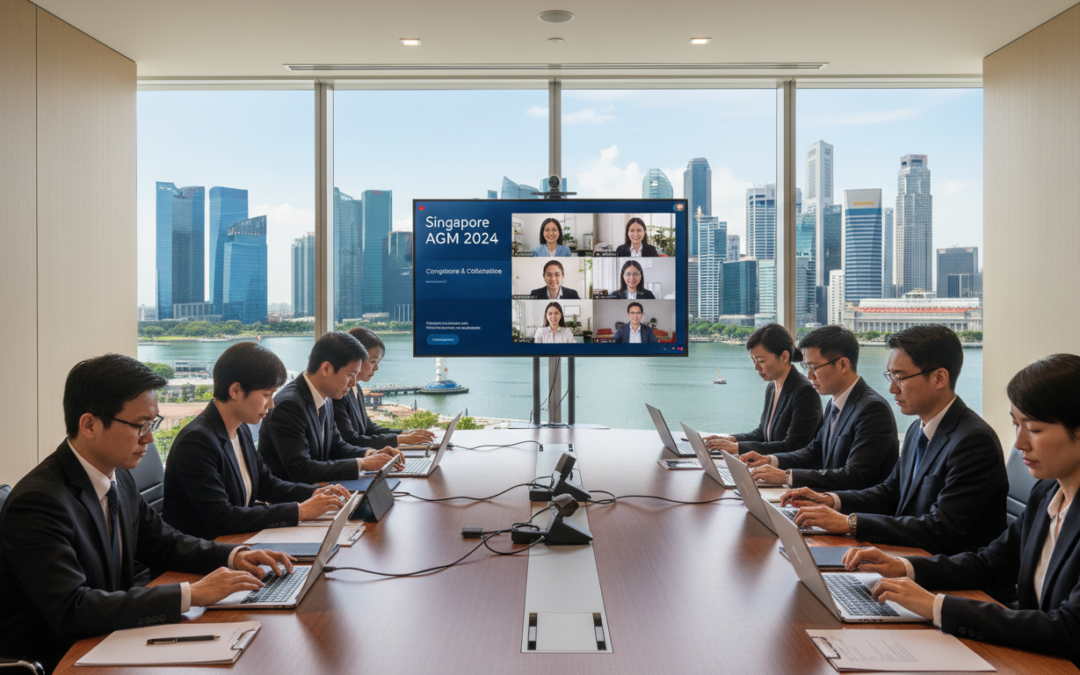
I remember the first time our board debated how to run a company gathering after the pandemic — it felt urgent and personal. Many directors sought clear, practical answers that honoured shareholder rights while using new tools. This guide speaks to that need for plain compliance and sensible governance.
From 1 July 2023, the Companies Act changed how companies singapore may hold general forums. The statutory baseline now sits alongside a company’s constitution and, for listed firms, SGX expectations. Readers planning an AGM or EGM will find concrete steps to avoid common pitfalls.
This article focuses on notice content, proxy handling, quorum, voting and access to documents. It explains the practical implications of the new regulations and updated practices. You will also get a high‑level checklist so you can confirm eligibility, pick a format, prepare notices and record outcomes.
Governance intent: digital convenience must not dilute shareholder rights. The guide will link each operational step back to statutory protections and offer actionable information and opportunity for compliant, effective meetings.
Key Takeaways
- New Companies Act framework (from 1 July 2023) provides permanent options beyond temporary pandemic orders.
- Check your constitution and SGX guidance if you are a listed issuer.
- Focus on notice, proxies, quorum and secure voting to keep resolutions valid.
- Use the checklist: eligibility, format, notice, access, voting, and documentation.
- Prioritise shareholder rights; governance should guide every operational choice.
What changed in Singapore’s Companies Act for virtual and hybrid general meetings
A permanent statutory framework replaced the pandemic orders to give companies long‑term clarity on how to hold corporate gatherings.
From temporary orders to a lasting framework
The COVID‑19 (Temporary Measures) Orders began in April 2020 to allow remote attendance. Those emergency provisions ended and a new regime took effect on 1 July 2023 under the Companies, Business Trusts and Other Bodies (Miscellaneous Amendments) Act.
Permitted formats and covered gatherings
The law now recognises three permitted formats: physical-only, hybrid and fully virtual. Each format changes logistics, attendance and how evidence of participation is recorded.
- Covered meeting types: annual general meetings, extraordinary general meetings, statutory meetings, class meetings and amalgamation approval meetings.
- Certain court‑ordered hearings under sections 182 and 210 also fall within the framework.
- Technology note: “virtual meeting technology” is a legal concept about enabling participation and secure voting, not a specific vendor.
- Check for any Gazette exclusion that may bar fully virtual formats for your company.
| Format | Logistics | Attendance evidence |
|---|---|---|
| Physical | Venue, papers, in‑person proxies | Signed registers, headcount |
| Hybrid | Venue plus broadcast and conferencing tech | Electronic sign‑in and recorded streams |
| Fully virtual | Online platform, secure voting tools | System logs and verified identities |
Business impact: These changes reduce friction for geographically dispersed stakeholders but demand robust governance and documentation. The next section will set out what companies can and cannot do, and how constitutions interact with the statutory default.
virtual meetings agm singapore rules: what your company can and cannot do
The statute gives clarity on permitted formats and on when a company may lawfully prevent remote participation.
Meeting types you can run under the amended framework
The law allows fully electronic, hybrid and physical formats for most general meetings. This covers annual and extraordinary gatherings, class meetings and other statutory forums.
Decision point: confirm whether your company will use an electronic or mixed format for upcoming general meetings and ensure the chosen format meets the statutory requirements.
When a constitution change is optional and when it can exclude formats
No amendment is necessary to enable electronic or hybrid formats because the default statutory permission applies. That said, a company may adopt a constitution that expressly excludes those formats.
Rule of thumb: companies incorporated before 1 July 2023 are covered automatically unless they amend the constitution on or after that date. Companies formed on or after 1 July 2023 may opt out at incorporation or later.
Listed issuers and SGX alignment
Listed issuers face a dual compliance track: Companies Act obligations plus Singapore Exchange practice notes. Directors must document operational arrangements, identity verification and how synchronous participation will work.
| Topic | Default Position | How to Exclude |
|---|---|---|
| Use of electronic format | Permitted by statute | Amend constitution to prohibit |
| Companies incorporated pre-1 Jul 2023 | Covered automatically | Constitutional amendment on/after 1 Jul 2023 |
| Companies incorporated post-1 Jul 2023 | Can exclude at incorporation | Set exclusion clause in constitution |
| Listed issuers | Statute + Singapore Exchange practices | Follow SGX practice notes and disclosures |
Plan your AGM timeline and eligibility, including AGM exemptions for private companies
Start your timeline at the financial year‑end so statutory deadlines guide every step. Publicly listed companies must hold annual general gatherings within four months after the end of the financial year. Non‑listed companies have a six‑month window.
Use a backwards planner. Map key milestones: prepare accounts, circulate papers, issue notices and allow time for proxy arrangements. This helps shareholders receive accounting and governance insights in good time.
Private company exemption and key safeguards
Since August 2018 private companies may skip holding an annual general meeting if they circulate financial statements to members within five months after year‑end.
That exemption is not absolute. A member can require a meeting by notifying the company no later than 14 days before the end of the sixth month after financial year‑end. Directors must then convene the meeting within six months after year‑end.
There is also a post‑circulation trigger: if a member or the auditor requests a meeting within 14 days after statements are sent, the company must hold the general meeting.
“Plan early, circulate promptly and respect member rights so accountability is never sidelined.”
Practical note: if an AGM is required under these safeguards, the company can still choose a compliant physical, hybrid or electronic format subject to its constitution and any exchange expectations.
Prepare compliant notices, agendas and shareholder communications for a virtual AGM
Clear, timely notices turn legal requirements into practical steps that protect shareholder rights.
Mandatory contents must include the date, time and the effective place — for online formats the access instructions act as the place. The agenda should list the matters to be decided and state whether a special resolution is required.
Notice periods are statutory: allow at least 14 days for an ordinary resolution and at least 21 days for a special resolution. Add practical buffers for platform testing and member support to reduce last‑minute issues.
Set out proxy and voting instructions in the notice. Explain how a person may appoint a proxy, how to submit proxy instructions, the deadline and acceptable electronic channels for delivery.
Issue notices electronically where permitted — email, company website, fax or other electronic services — and match the method to shareholder preferences. Keep a reliable record of dispatch and access so you can evidence what information was available, when, and via which channel.
Share meeting papers in advance: financial statements, auditor notes and explanatory notes for each resolution. Private businesses relying on the AGM exemption must circulate accounts within five months after year‑end.
For a practical template and terms governing electronic dispatch, see the company’s notice and delivery policy. Ensure access guidance and user support are clear so shareholders can participate and vote with confidence.
Run the meeting properly: proxies, quorum, voting and shareholder rights online
Running a compliant meeting demands tight operational checks from opening formalities to vote recording. Start by stating the format, confirming the chair and declaring how attendance will be verified.
Accepting proxy appointments: the company must accept proxy instruments and proxy instructions by the electronic channels specified in the notice. Test submission, confirmation and upload processes before the meeting so proxies are recorded and auditable.
Quorum and attendance
Each person joining remotely counts towards quorum. The chair should announce the quorum at the start and note continuing presence at key agenda items.
Rights to be heard and speak on resolutions
Provide at least one reliable synchronous channel (for example live audio with moderated Q&A). Allow shareholders to raise representations and ask questions in real time.
Voting, identity checks and shows of hands
Use secure electronic voting or constitutionally permitted methods. Ensure audit trails exist and use unique access codes or verified lists to authenticate voters. An electronic show of hands is valid only where participants can be identified by prescribed or director‑approved methods.
Documents and auditor’s report: make registers, lists of members, and the auditor’s report available on a website during the meeting or by other means approved at an ordinary resolution. Read the auditor’s report aloud via the synchronous channel if required.
“Document contingency steps, test systems and keep incident logs so shareholder protection is never left to chance.”
| Operational step | Practical action | Why it matters |
|---|---|---|
| Open meeting | Confirm chair, format and quorum | Establishes lawful start |
| Proxy handling | Accept electronic instruments and confirm receipt | Ensures valid voting |
| Disruption plan | Pause/resume, backup dial‑in, extended voting window | Minimises risk of substantial injustice |
Conclusion
Companies now operate under a lasting framework that balances technology use with shareholder protections. The 1 July 2023 change makes clear that compliant use of electronic tools is a permitted option under the new virtual meetings agm singapore rules and related regulations.
Practical takeaways: choose the right format, confirm your constitution, meet AGM timing and issue compliant notices. A company should check proxy processing, quorum tracking and secure voter identification well before the end of the financial year.
For listed issuers, implement Companies Act obligations alongside market practice. See the SGX guidance on general meetings for detailed expectations: SGX practice note on general meetings.
Next steps: assign owners (company secretarial, IT, IR), run rehearsals, prepare contingency plans and keep logs. Good execution turns compliance into an opportunity to deliver clear accounting insights and meaningful shareholder engagement.
FAQ
What is the new statutory framework for hybrid and fully virtual general meetings that took effect on 1 July 2023?
Which types of companies and meeting formats are covered by the amended Companies Act?
Can a company’s constitution prevent meetings from being held without a physical venue?
How do listed issuers reconcile Companies Act requirements with SGX RegCo practice notes?
What are the AGM deadlines after financial year‑end for listed and non‑listed companies?
How can a private company use the AGM exemption by circulating financial statements on time?
What safeguards can force an AGM even when an exemption is claimed?
What must be included in a notice of meeting for a hybrid or fully remote general meeting?
What are the notice periods for ordinary and special resolutions?
Is it acceptable to issue notices electronically, and what are best practices?
How should companies share financial statements and meeting papers to support informed shareholder decisions?
Can proxy appointments and instructions be accepted electronically?
How is quorum determined when participants attend by electronic means?
How can shareholders exercise the right to be heard and speak on resolutions during a remote meeting?
What voting methods are acceptable and how should identity verification be handled?
Are members entitled to inspect documents such as registers and auditor’s reports during the meeting?
How should companies handle technical disruptions and do outages invalidate a meeting?
What steps can boards take now to prepare for compliant hybrid or fully remote general meetings?

A Singapore-based B2B growth expert, Dean Cheong leads VOffice as CEO, helping organizations grow faster through structured sales execution, CRM transformation, and market expansion strategies. Backed by formal training in finance and business banking from Nanyang Technological University, he focuses on building performance-driven systems that support long-term commercial success.